Finance internships for international students, and who sponsors
Which finance firms confirm visa sponsorship, what a posting's eligibility line says, how CPT and OPT work, and where the openings outside the US are.
By Michael Botti and John Botti


8 min read
If you are an international student, the hardest question in finance recruiting is often not whether you are a strong candidate. It is whether the firm can hire you at all. Postings rarely lead with that answer. It sits in one line near the end of the eligibility section, and it can end an application before anyone reads your resume.
This post covers what the tracker records about visa sponsorship, what the postings themselves say, how US work authorization for F-1 students works in plain terms, where the openings outside the US are, and what to ask before you spend a week on an application. None of it is legal advice. Rules change and your case is your own, so check with your school's international student office before you act on anything here.
What does Internvest record about visa sponsorship?
The tracker records sponsorship for each firm, not for each opening. A firm is marked as confirming that it sponsors visas, as saying it does not, or as unreported when it has not said. The recruiting report counts it over every firm with an opening on the tracker: of those 612 firms, 56 confirm sponsorship, 26 say no, and 530 leave it unreported. Unreported is not a hidden no. Many firms publish no policy at all, and the tracker does not guess.
The firms that confirm are few, but they are large employers: they hold 2,530 of the 9,277 openings the tracker counts on the ten paths, every type and cycle. By path, the most are 735 in investment banking, 495 in sales and trading and 467 in asset management.
Openings at firms that confirm visa sponsorship, by path
Each path's openings Internvest tracks, every type and cycle, and how many are at a firm the tracker records as confirming visa sponsorship: 56 of the 612 firms with an opening, as the recruiting report counts them, as of October 29, 2026.
- Investment Banking735 of 1,826 openings
- Management Consulting138 of 940 openings
- Sales and Trading495 of 1,087 openings
- Asset Management467 of 1,865 openings
- Hedge Funds204 of 562 openings
- Private Equity47 of 326 openings
- Private Credit22 of 146 openings
- Real Estate37 of 565 openings
- Venture Capital0 of 52 openings
- Corporate Finance385 of 1,908 openings
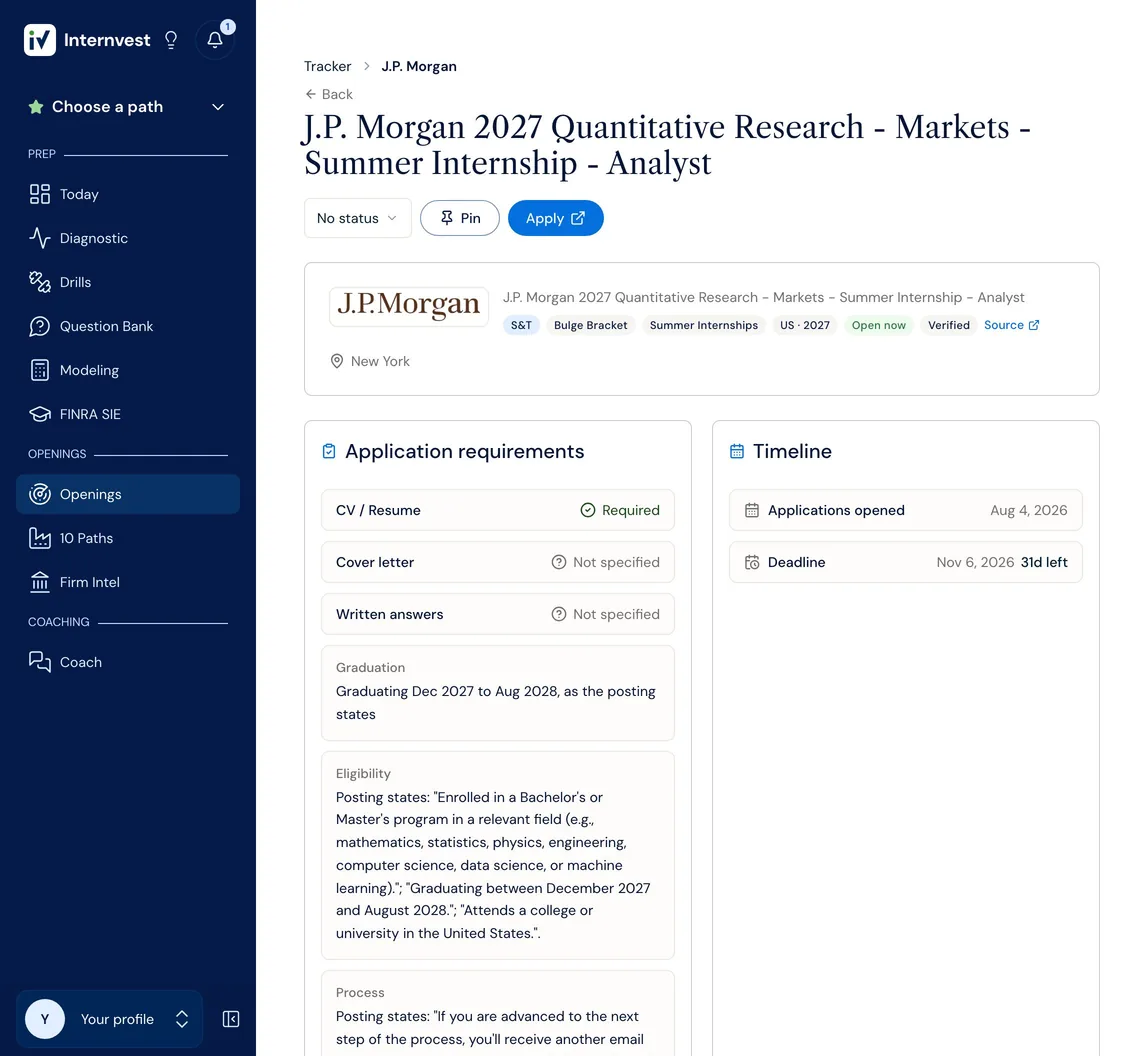
Each firm page shows the flag. Goldman Sachs, Morgan Stanley, Evercore, Jane Street, Citadel and BCG are among the firms marked as sponsoring visas, and each page lists the firm's tracked openings by name. The visa sponsorship page lists every firm that confirms and every firm that says no, A to Z, with its openings.
Does a firm that sponsors visas sponsor every role?
Not necessarily. A firm-level yes tells you the firm sponsors somewhere. It does not tell you about the role in front of you, in that office, for that year. That answer is in the posting's own eligibility line.
The tracker records the stated eligibility of 4,580 openings, and 713 of them carry a line about work authorization or sponsorship. Read by pattern, 570 of those lines rule sponsorship out for the role: no sponsorship now or in the future, permanent work authorization, or citizenship. Only 28 say sponsorship is available or may be, some of them only for certain degrees. The other 115 set a condition without saying either way, such as the right to work in the country of the office. The lines are read by pattern, so the split is approximate.
The two signals can disagree. At 14 of the firms that confirm sponsorship, at least one posting's own line rules it out for that role, 63 openings in all. So read the eligibility line before anything else. Three phrasings come up again and again:
- "Without sponsorship now or in the future." The firm is telling you it will not file for a work visa for you later either. That excludes a student who would need one to stay on after practical training, even when practical training would cover the internship itself.
- "Permanent work authorization" or citizenship. Closed to students on a student visa.
- "Authorized to work in the US", and nothing more. Ambiguous. Practical training may count. Ask the recruiter before you apply.
How does US work authorization work for F-1 students?
In plain terms, from the government's own pages:
- Nothing before authorization. You must be authorized before any practical training starts, and the first step is your designated school official, the person at your school who manages your student record (Study in the States, Training Opportunities in the United States, read October 5, 2026).
- The first year. USCIS says F-1 students may not work off campus during their first academic year. After it, three kinds of off-campus work open up: curricular practical training, optional practical training before or after you finish, and the STEM extension of optional practical training (USCIS, Students and Employment, read October 5, 2026).
- CPT, curricular practical training, is work that is an integral part of an established curriculum, such as a required internship or co-op offered through agreements with your school. It can be full time. Your school official authorizes it and gives you an updated Form I-20 before you start. One catch from the same Study in the States page: a year or more of full-time CPT makes you ineligible for OPT after you finish.
- OPT, optional practical training, is work directly related to your major, up to 12 months at each degree level. Before you finish, it is limited to 20 hours a week while school is in session and can be full time in breaks. Months used before you finish are deducted from the months available after. Your school recommends you, you file Form I-765 with USCIS, and you cannot start until you hold the Employment Authorization Document (USCIS, Optional Practical Training, read October 5, 2026).
Which one fits a summer internship depends on your school's own CPT policy, which is why the government's pages send you to your school official first.
After graduation, one route into a full-time role once OPT ends is the H-1B visa. The employer is the one that petitions, and the job must normally call for at least a bachelor's degree in a related field. The USCIS page opens with 2026 alerts about fee and payment rules for petitions, so read it as it stands when you need it (USCIS, H-1B Specialty Occupations, read October 5, 2026). That kind of filing is what a posting rules out when it says "now or in the future".
Where are the finance openings outside the US?
Outside the US, the tracker counts 4,160 openings of its 9,277: 1,469 in Europe, 1,059 in Asia, 1,056 in the UK, 473 in Canada and 103 in the Middle East. Europe here means continental Europe; the UK is counted on its own. If you already hold the right to work in one of those places, through citizenship or residence, that market skips the sponsorship question entirely.
The mix of roles differs too. Outside the US, off-cycle internships are a far larger share of the openings: 1,183 of the 4,160 openings outside the US are off-cycle, against 460 of the 5,117 in the US. By region, that is 610 of the 1,469 openings in continental Europe, 247 of the 473 in Canada, 148 of the 1,056 in the UK, 147 of the 1,059 in Asia and 31 of the 103 in the Middle East.
Openings outside the US, by region
The 4,160 openings Internvest tracks outside the US, every type and cycle, by region, with the off-cycle internships in each, as of October 29, 2026.
- Continental Europe1,469 openings
610 off-cycle, 859 of every other type
- Asia1,059 openings
147 off-cycle, 912 of every other type
- The UK1,056 openings
148 off-cycle, 908 of every other type
- Canada473 openings
247 off-cycle, 226 of every other type
- The Middle East103 openings
31 off-cycle, 72 of every other type
An off-cycle role runs for a semester or longer outside the June to August slot, and some, in Europe especially, ask that you still be enrolled while you work, so read the eligibility line. Off-cycle internships, explained covers how they differ from a summer internship and when to apply.
What about the UK and Canada?
The UK. GOV.UK says that on a Student visa, how much you may work depends on what you are studying and whether the work is in or out of term time (GOV.UK, Student visa, read October 5, 2026). After an eligible UK course, the Graduate visa lets you stay for 2 years if you apply on or before December 31, 2026, and 18 months if you apply on or after January 1, 2027 (GOV.UK, Graduate visa, read October 5, 2026). For a job after that, the Skilled Worker visa needs an employer approved by the Home Office and a certificate of sponsorship from that employer (GOV.UK, Skilled Worker visa, read October 5, 2026). So in the UK, a firm that sponsors is a licensed employer that issues that certificate.
Canada. Since April 1, 2026, post-secondary international students at a Canadian designated learning institution do not need a co-op work permit for a work placement their course of study requires. The placement must be half of the course or less, and you need a letter from your school confirming it is required (Canada.ca, Work in a student work placement, read October 5, 2026). Outside a placement, a student who qualifies can work off campus up to 24 hours a week during terms and without a limit in scheduled breaks (Canada.ca, Work off campus as an international student, read October 5, 2026).
One caution for both: these are rules for students at a UK or Canadian school. The Canadian page says student placements are not for students at schools outside Canada, and that a student who is not eligible needs a work permit. If you study in the US and want a summer in London or Toronto, ask the firm what you would need.
What should you ask a firm, and your school?
Ask the firm, through its recruiter, at an event, or an analyst you meet for a coffee chat (how to run one):
- Does this role, in this office, sponsor? Ask about the internship and the full-time offer separately.
- Do you take students on CPT or OPT for the internship?
- If I receive a full-time offer, would you file for a work visa, and when?
- For an office outside the US: do I need the right to work there already?
Ask your school's international student office:
- Does our school authorize CPT for a summer internship, and what does it require: a course, credits, a timeline?
- How would CPT or OPT before graduation affect my OPT after it?
- How long does an updated I-20 or an OPT recommendation take?
- If I take an off-cycle term, what happens to my enrollment and my status?
What to do this week.
- Start your list from the firms that confirm sponsorship, then open each posting and read its eligibility line before you read anything else.
- Book a meeting with your international student office and bring the questions above.
- If you hold the right to work in another country, add that market's firms to your list.
- See how an opening's status reads on the free is it open tool, and check the path hubs for investment banking, sales and trading and corporate finance, where the confirming firms post the most.
- If you are a junior, the juniors page lists 1,749 openings not yet closed at 377 firms.
The deadlines page lists the tracked openings on every path by firm, with each path's hub one click away.
Figures as of October 29, 2026, computed from the Internvest tracker.